
Token Unlock Schedule: Find Upcoming Unlocks
How to find a token unlock schedule: upcoming cliff and linear unlocks with USD value and share of market cap, step by step in Token Radar.
 Written by taika · Creator of Token Radar
 To find a token unlock schedule, start with an unlock calendar that lists upcoming releases across many tokens, then open the token's own vesting schedule to see which allocations unlock, on which dates, and how many tokens each release adds.
An unlock schedule is one part of a token's supply picture; our guide to how tokenomics works covers vesting, circulating supply and FDV. This guide is the practical side: where the data lives, how to read it and how to size an event. Here is what the next 30 days hold:
- Unlocking in the next 30 days
- $706.4M
- at today’s prices
- Tokens with an unlock
- 176
- New issuance in the same 30 days
- $1.86B
- newly created tokens, not unlocks
- Cliffs among them
- 2
- $498.3K on the Largest Cliffs cards
How to check token unlocks?
Find what unlocks with a calendar across tokens, size each release against market cap, then check its schedule and sources. Six steps, each with the place on Token Radar where you do it:
| Step | What to check | Where on Token Radar |
|---|---|---|
| 1. List the window | Every release in the next 7 or 30 days, across tokens rather than project by project | Overview, period 30D |
| 2. Rank by relative size | The share of market cap, not only the dollar value: a large dollar figure on a large token can be routine | Overview table sorted by % MCap, or the ≥1 % MCAP pill |
| 3. Find the busy days | Days that bunch several releases together | Calendar heatmap |
| 4. Open the full schedule | Cliff or one step of ongoing vesting, which allocation receives it, how much stays locked | The token's Tokenomics tab: chart and Allocations |
| 5. Check the evidence | Whether the release is researched or estimated, and which documents it rests on | Cliff cards; the Tokenomics tab's Assumptions and Sources |
| 6. Recheck before the date | Changes since the schedule was researched | The Tokenomics tab's Sources, then the project's own documents |
Step 2 filters hard. Of the 41 tokens among the 300 largest by market cap that unlock between 10 October and 8 November 2026, 12 release 2.5% of their market cap or more over those 30 days, and only 3 release 5% or more: Humanity Protocol, Official Trump and LayerZero. Data as of 2026-10-10 02:02 UTC, source: Token Radar.
For a ready-made list, our monthly roundup of the largest token unlocks this month ranks the month's largest releases, with links to each token's schedule.
What does a token unlock schedule show?
A token unlock schedule, or vesting schedule, is the timetable that says when locked tokens become transferable, allocation by allocation. Our explainer on what a token unlock is covers the mechanics; these are the fields to read:
| Field | What it tells you | Watch for |
|---|---|---|
| Date | When the tokens unlock | The time zone: a release at 00:00 UTC can fall on the previous day in the Americas. Some releases are dated only to their month. |
| Type | Cliff, installment or continuous vesting | Whether the release is a one-off or one step of many |
| Amount | The number of tokens and their value at the current price | The dollar value moves with the price; the token count does not |
| Allocation | Who receives the tokens: team, investors, ecosystem, treasury, community | Labels are the project's own and vary between projects |
| Evidence and sources | How the date and the amount were established | An estimated release rests on assumptions, not on a stated date |
| Progress | How much supply is unlocked and when it is fully unlocked | What stays locked after the next release |
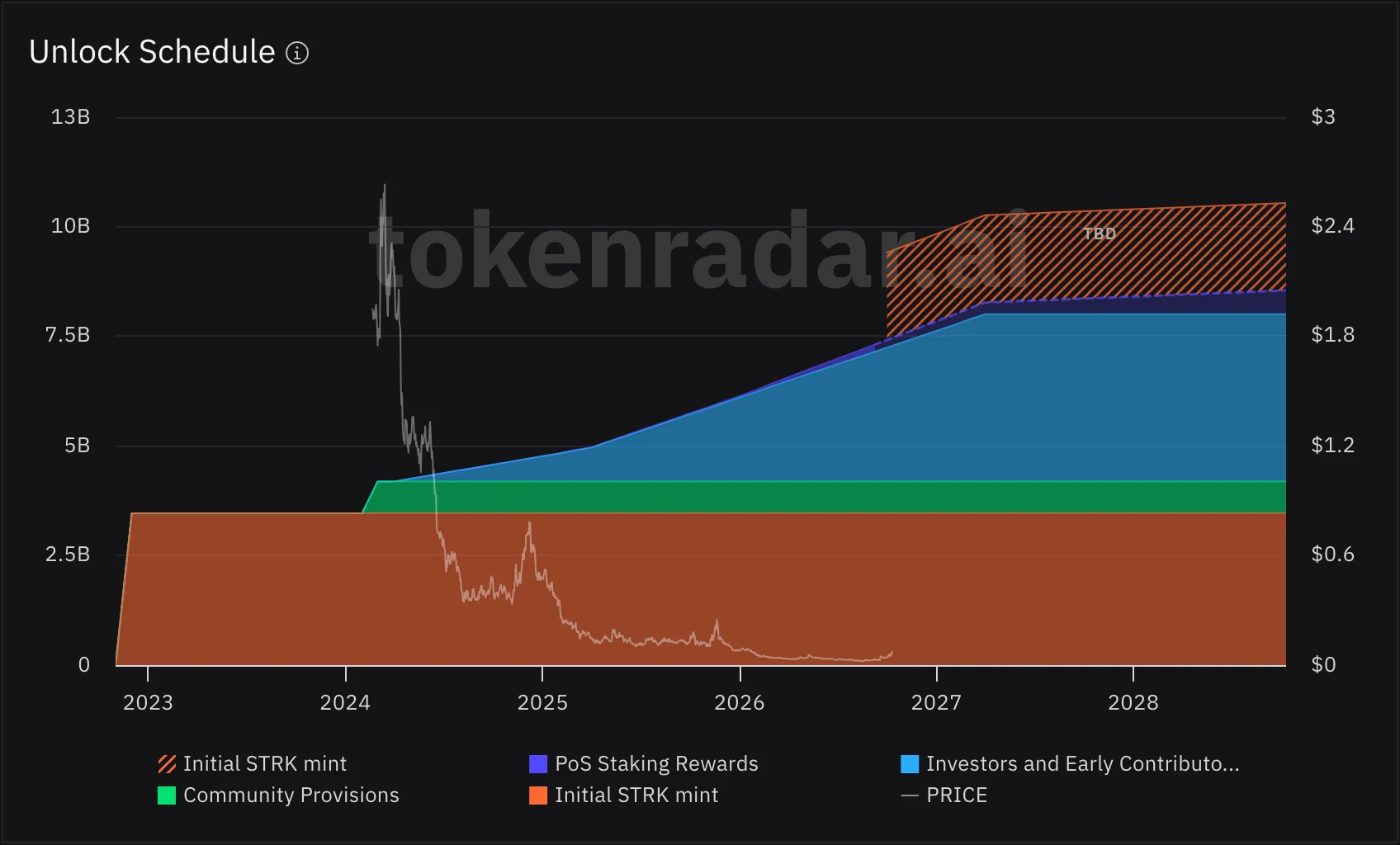
StarkNet shows the fields in one row: on 15 October 2026 its schedule releases 127 million STRK to the combined allocation of investors and early contributors, an installment dated to the day and marked researched, worth $9.3 million or 1.68% of market cap. Data as of 2026-10-10 02:02 UTC, source: Token Radar.
What is the difference between a cliff and a linear unlock?
A cliff releases a block of tokens on one date. Linear vesting releases them gradually over months or years, in installments on a payment day or a little every day. On a calendar the two look very different:
| Cliff | Linear vesting | |
|---|---|---|
| How it releases | A block on one date, often after a one-year lock for team and investor tokens | Equal steps on a payment day, or a small amount every day, for example over 24 or 36 months |
| On a calendar | One tall day | Many small days, month after month |
| What to check | Who receives it, and whether vesting starts after it | The monthly total, not the daily amount |
The small days add up. Official Trump's schedule releases about $1.7 million a day, 0.32% of its market cap. Over the 30 days from 10 October that is $51.2 million, 9.58% of market cap, and about 186 times the largest cliff in the same window, Initia's $274.3K. Across all tokens, cliffs are a sliver of what unlocks. Data as of 2026-10-10 02:02 UTC, source: Token Radar.
| Release | Unlock value |
|---|---|
| Installments on a payment day | $421.4M |
| Continuous, every day | $279.9M |
| Cliffs | $353.6K |
Why do unlock numbers differ between sites?
Sources count different releases and date the same vesting differently. Before you compare two totals, check which of these each one does:
| How a source counts | What you see |
|---|---|
| Cliffs only | Installments and daily vesting are missing: of the $706.4M above, $353.6K would remain |
| Monthly totals | Installments and daily vesting rounded into one step per month |
| Per day or per block | Continuous vesting as a small amount every day |
| Month-only releases on one date | A release whose day the sources do not give, at its full amount on a single day |
Token Radar follows each schedule's own cadence: installments fall on their payment dates, and continuous vesting appears as daily amounts. A release that the sources date only to its month is listed as, for example, "Oct 2026 · day not given" with its whole month's amount, and spread evenly over the month's days in the charts.
How big is a big token unlock?
There is no universal threshold; an unlock figure only means something next to a denominator. Three are worth checking:
- Market cap or circulating supply. The unlock value divided by market cap is the release as a share of what the market already values. With market cap computed from circulating supply, as it usually is, this equals the unlocked tokens divided by circulating supply.
- Trading volume. A release worth a fraction of a normal day's volume is different from one worth several days of it. For a large event, look at the markets where the token actually trades.
- The rest of the schedule. A cliff that ends a long lock-up and starts monthly vesting changes the supply for the months after it, not only on the day.
The share of market cap is a calculation you can redo: unlock value ÷ market cap. Three releases in the next 30 days, one in each highlight band:
| Release | Unlock value | Market cap | Share of market cap |
|---|---|---|---|
| StarkNet, 15 Oct | $9.3M | $552.5M | |
| AltLayer, 25 Oct | $1.8M | $59M | |
| KAITO, 20 Oct | $5.5M | $76M |
KAITO's release is smaller than StarkNet's in dollars and more than four times heavier against its market cap. Data as of 2026-10-10 02:02 UTC, source: Token Radar.
Does a token unlock mean the tokens will be sold?
No. A scheduled unlock, a claim and a sale are separate events, and only the first is on the schedule. What is a token unlock? walks through each step.
| Event | Where you can see it | What it proves |
|---|---|---|
| Unlock | The schedule: Token Radar's calendar and the token's Tokenomics tab | The tokens become eligible for release |
| Claim or transfer | A block explorer, on the vesting contract or the recipient's address | The recipient moved the tokens: on the day, weeks later or not for a long time |
| Transfer to an exchange address | A block explorer with labelled exchange addresses | A sale became possible, not that it happened |
| Sale | Only indirectly: exchange trades do not name the seller | Nothing a schedule can tell you in advance |
A schedule can even move before its date. Morpho's co-founders, who hold 15.2% of MORPHO, agreed to relock their tokens into an additional two-year linear vest; according to Morpho's documentation, they are fully vested by 17 May 2028 at the latest. Token Radar lists the allocation as "Founders, relocked".
Price can move around an unlock date for many unrelated reasons: the broader market, product news, listings, liquidity and derivatives positioning. Use the schedule as research context, not as a trading signal on its own.
How to do this in Token Radar
Token Radar brings the schedules of the tokens it researches together in Token Unlocks, with four tabs: Overview, Calendar, Largest Cliffs and Issuance. Each token's Tokenomics tab holds its full schedule.
Scan the token unlocks overview
Open the token unlocks overview. Four controls decide what it shows:
| Control | Options | What it does |
|---|---|---|
| Period | 30D, the default and free; 1D, TODAY, 7D, WTD, MTD, 90D, QTD, 12M and YTD with Premium | Sets the window that every tile and the table cover |
| Pills | CLIFFS, ≥1 % MCAP, TOP-100, TOP-300 | Narrow the view to cliffs, to unlocks of at least 1% of market cap, or to the largest tokens by market cap |
| Unlock Volume | BY TOKEN or BY SECTOR; a BROKEN (default) or NORMAL axis | Shows the USD value unlocking per day, or per month for periods longer than a quarter; a click on a token's column opens its Tokenomics tab |
| Table | Sorted by USD by default, or by % MCap | Lists each token's next unlock with its date, Type (Cliff, Scheduled or Mixed), USD, % MCap, market cap and sector |
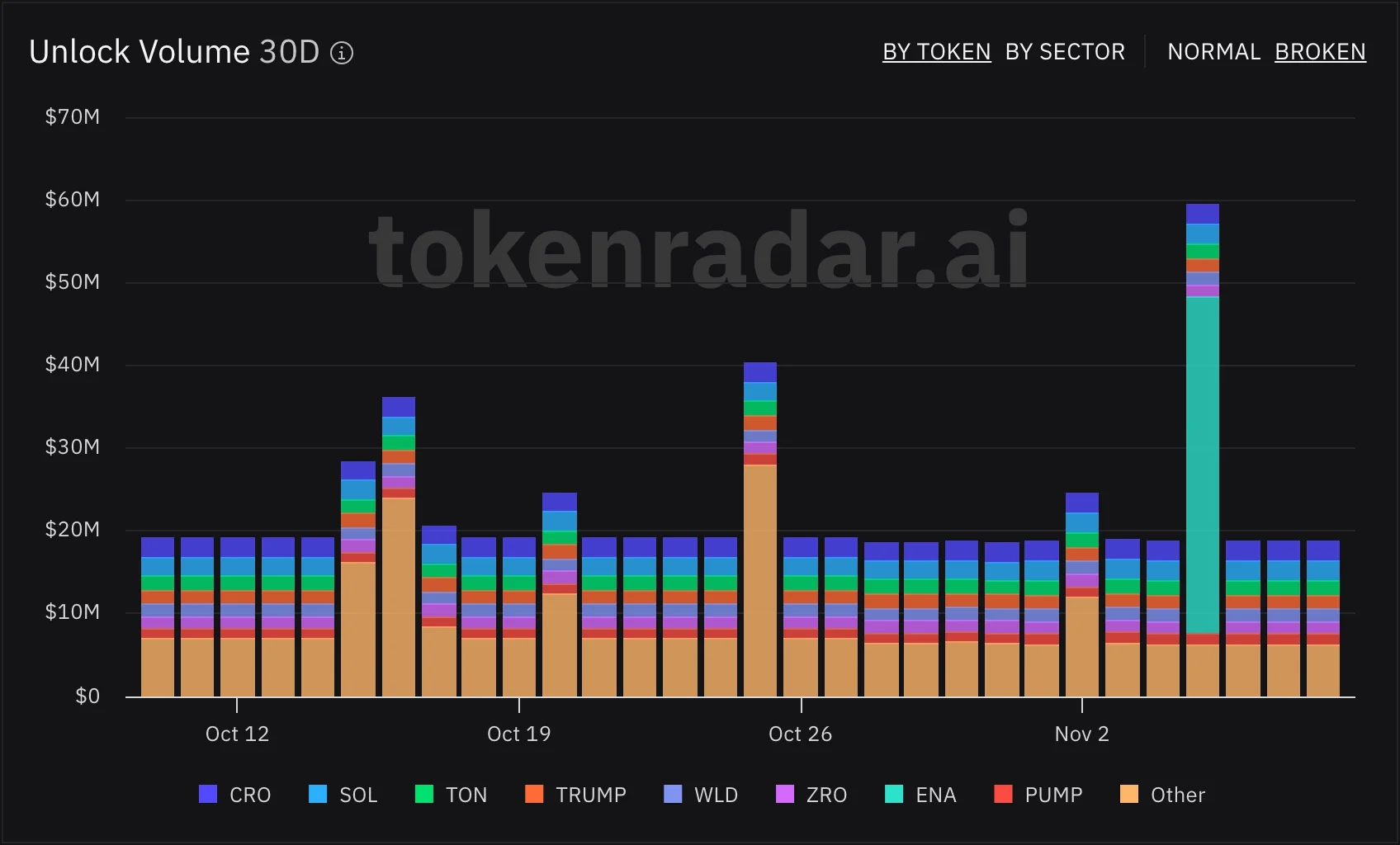
The side tiles summarize the same period: New Supply splits the new supply into unlocks and issuance, Largest Cliffs Ahead and Up Next list the next large releases, and Highest Unlock Pressure ranks tokens by share of market cap. New Supply is worth a look for any period: in the 30 days of the strip at the top, issuance adds about 2.6 times as much new supply as unlocks.
Check the unlock calendar
The unlock calendar shows the period as a heatmap, one cell per day with the USD value of the releases dated to that day:
- Pick the period; the heatmap covers it day by day.
- Select a day: the panel beside the heatmap lists its unlocks, sorted by USD or % MCAP.
- Narrow the Upcoming Unlocks list below with its filters: the type (ALL, CLIFF, SCHEDULED), a minimum share of market cap and a token search.
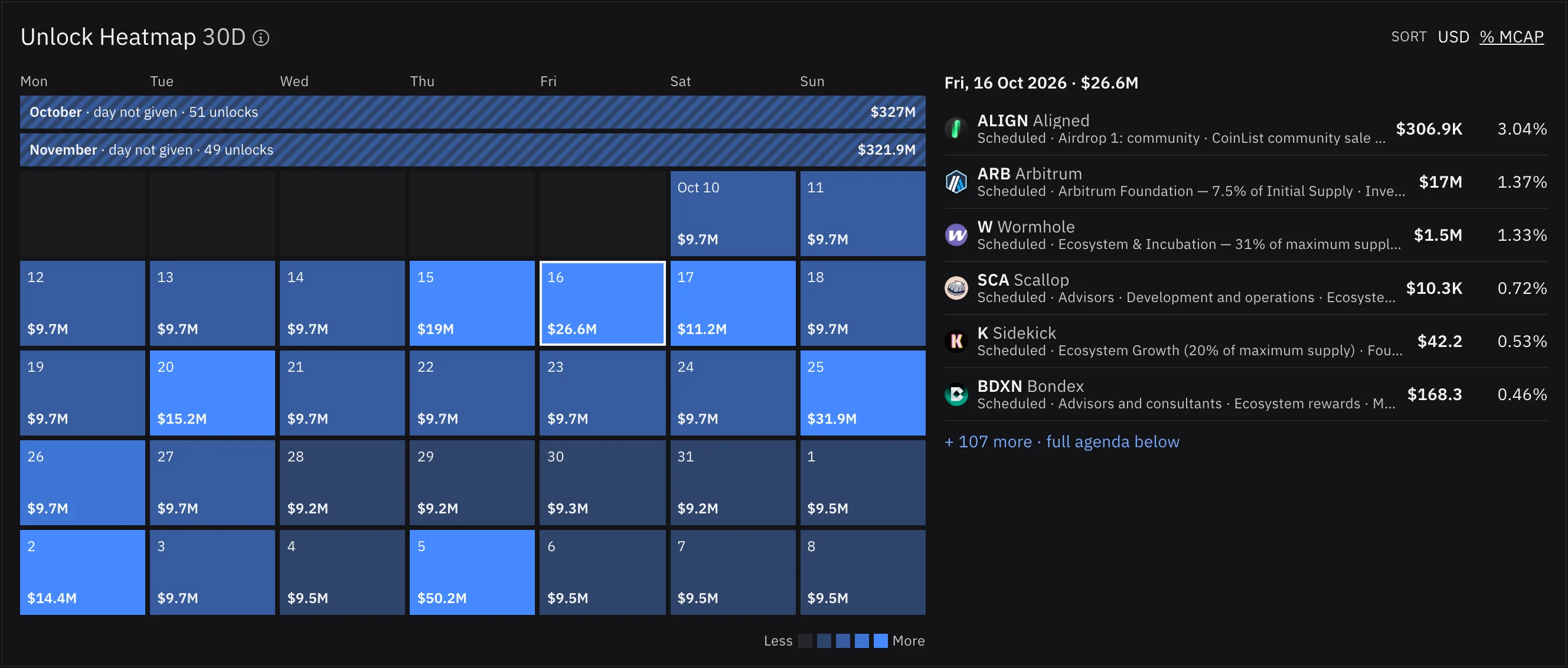
Releases dated only to their month stay out of the cells: they appear once, at their whole month, in a hatched lane above the days, and selecting the lane lists them in the panel. In the capture above, taken 2026-10-10 03:44 UTC, the cell for 16 October and the panel's heading both read $26.6M, and the October lane $327M for 51 unlocks.
Review the largest cliffs
The Largest Cliffs tab shows one card per cliff in the selected period. Each card gives:
- the unlock date, or the month when the day is not given
- the unlock value in USD
- its share of market cap
- the evidence level, such as researched or estimated
- the allocation and its tokens, with a chart of the token's modeled release over the period
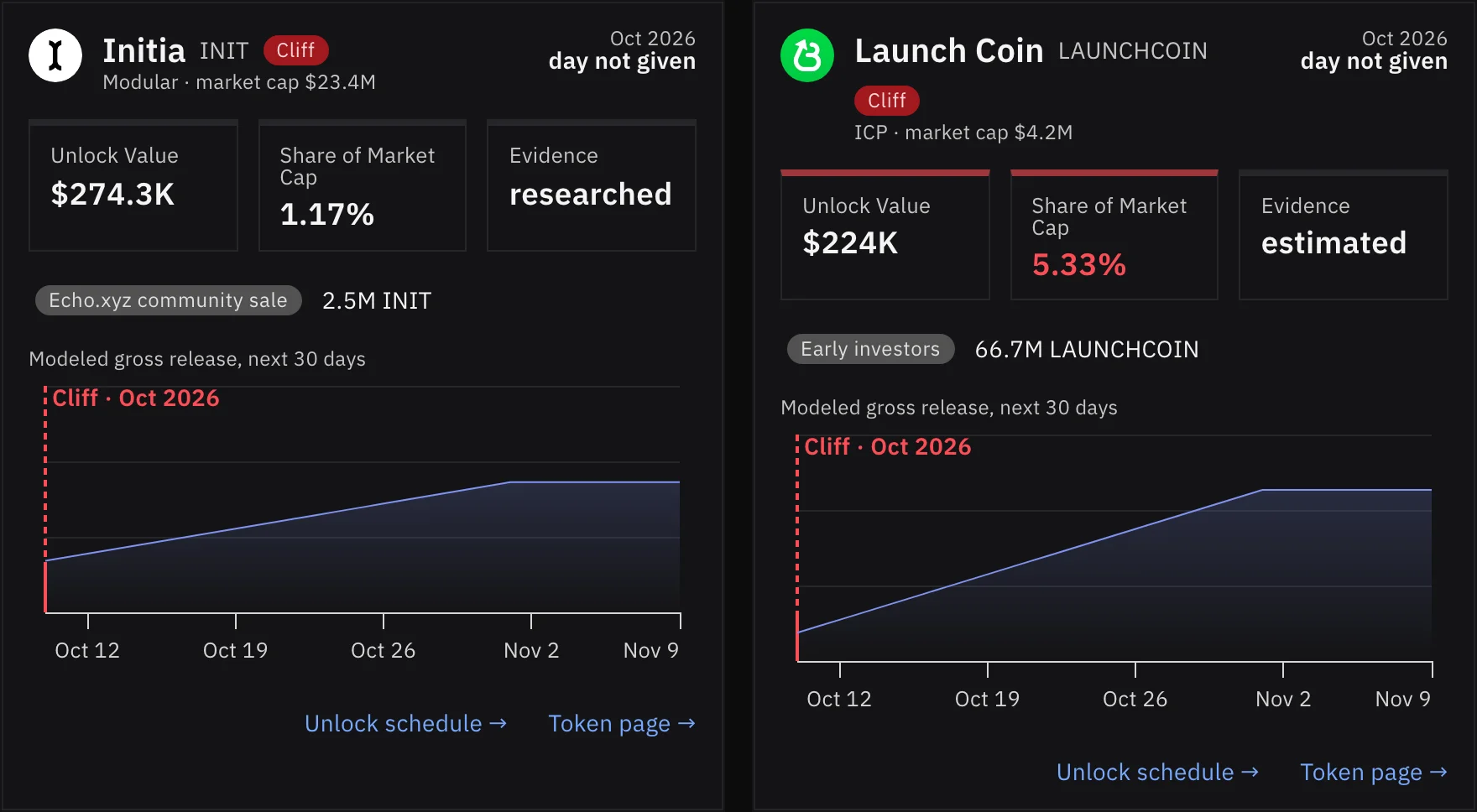
In the 30 days from 10 October 2026 the tab shows only two cards, both dated only to October: Initia's researched cliff of its Echo.xyz community sale ($274.3K, 1.17% of market cap) and Launch Coin's estimated cliff for early investors ($224K, 5.33%). Data as of 2026-10-10 02:02 UTC, source: Token Radar. When no cliff falls in the period, the tab says so.
Open a token's Tokenomics tab
Every token in these views links to its Tokenomics tab, for example StarkNet tokenomics. Its parts:
- The unlock chart stacks the allocations over time with the token's price on top; hover a date to see what unlocks.
- Tokenomics Overview gives Total Supply, Unlocked Supply, Unlock Progress, Genesis Date, Fully Unlocked and the number of Allocations.
- Assumptions summarizes the research behind the schedule and names the allocations whose release dates the sources do not give; its Sources list links the documents.
- Allocations gives each allocation's share, token amount and vesting terms.
From there, the token page has price, markets and news for the same token.
Related on Token Radar
- Token unlocks overview
- Token unlock calendar
- Largest cliff unlocks
- Docs: Token Tokenomics, each part of the Tokenomics tab explained
- Docs: Vocabulary, market cap, circulating supply and related terms
- The largest token unlocks this month
- What is tokenomics? The guide to supply, allocations, vesting and FDV