
Tokenomics explained: crypto token supply, FDV, vesting and unlocks
Tokenomics explained: supply, FDV, allocations, vesting and unlocks, shown on real unlock schedules such as Arbitrum's, with Token Radar data.
 Written by taika · Creator of Token Radar
 Tokenomics is the economics of a crypto token: the rules that decide how many tokens exist, who holds them, when locked tokens become transferable, how new tokens are created or removed, and why anyone would want to hold the token at all.
The word combines "token" and "economics"; this guide is about crypto tokens, not the pricing of AI model tokens. It explains each part in plain terms and reads one real token throughout: Arbitrum (ARB), from its 2023 airdrop to the monthly unlocks that run until 2027.
- ARB minted at launch
- 10B
- The rules allow up to 2% inflation a year
- Of the max supply circulating
- 68%
- Market Data tile
- Team, contributors, advisors and investors
- 44.47%
- 4.45 billion ARB
- Unlocking on 16 October 2026
- $16.9M
- 92.65M ARB, 1.36% of market cap
Each of these numbers comes out of Arbitrum's tokenomics: a supply minted at launch, an allocation table and a vesting schedule. The sections below show where each one comes from and how to read the same thing for any token.
What is tokenomics?
Tokenomics is the rulebook for a token's supply and incentives. Some rules are fixed in code at launch; others can change later through a governance vote or the team, so the rules live in several places:
| Where the rules live | What it settles | In Arbitrum's sources |
|---|---|---|
| Token documentation | Supply, allocation and vesting | The Arbitrum Foundation's docs, such as "What is the token circulating supply?" |
| On-chain records | What was minted, and when | The ARB deployment and initial mint transaction on Arbiscan |
| Governance proposals | Changes after launch | "AIP-1.1: Lockup, Budget, Transparency" on the Arbitrum forum |
| Reports | What a foundation or treasury holds and spends | The Arbitrum Foundation's transparency reports for 2023 and the first half of 2024 |
Arbitrum shows why any summary is a snapshot. All 10 billion ARB were minted at launch, yet the token rules permit inflation of up to 2% a year, and the ArbitrumDAO Treasury's 35.28% is released only when governance decides. Token Radar's Arbitrum schedule draws on 14 such sources and was last updated on 30 September 2026.
What are the key components of tokenomics?
Five components make up a token's tokenomics. Each answers one question, and each has a place on Token Radar where you can read it:
| Component | What it tells you | Where on Token Radar | Watch for |
|---|---|---|---|
| Supply | How many tokens exist and how many circulate | Market Data tile: Circulating Supply | A low circulating share |
| Allocation | Who received the supply at launch | Tokenomics tab: Assumptions and Allocations | A large share for insiders |
| Vesting and unlocks | When locked tokens become transferable | Unlock Schedule; Token Unlocks | Cliffs and unlocks that are large against market cap |
| Emissions and burns | How supply grows or shrinks over time | Issuance tab: Inflation / yr | Issuance that outpaces demand |
| Utility | Why anyone needs the token | Tokenomics tab: Tokenomics & Utility | A product that works without the token |
The sections below read each component on Arbitrum.
How much supply exists?
Three supply figures appear on almost every token page, and they are easy to mix up:
- Max supply: the most tokens that can ever exist under the current rules; some tokens have no maximum.
- Total supply: the tokens that exist now, locked ones included, minus any that were burned.
- Circulating supply: the part considered freely tradable today.
Arbitrum minted all 10 billion ARB at launch; only the inflation of up to 2% a year that its rules permit could add more. Token Radar's Market Data tile counts 68% of ARB's max supply as circulating. Data as of 2026-10-09 22:55 UTC, source: Token Radar.
Circulating supply is an estimate: data sources decide differently which wallets count as locked, so two sites can show different figures for the same token on the same day. Our guide to FDV vs market cap covers these definitions and their edge cases.
Who gets the tokens?
Allocation is how the supply is split between groups at launch: typically the team and advisors, early investors, a foundation or treasury, an ecosystem fund, airdrops, and rewards for users or validators. Projects use their own labels for the same kinds of groups.
| Allocation | Share of initial supply |
|---|---|
| ArbitrumDAO Treasury | 35.28% |
| Team, contributors and advisors | 26.94% |
| Investors | 17.53% |
| Initial user airdrop | 11.62% |
| Arbitrum Foundation | 7.5% |
| Airdrop to ecosystem DAOs | 1.13% |
For Arbitrum, the team, contributors and advisors (26.94%) and the investors (17.53%) together hold 44.47% of the initial supply, 4.45 billion ARB: more than the ArbitrumDAO Treasury's 35.28%. Their vesting drives Arbitrum's monthly unlocks. Data as of 2026-10-09 22:53 UTC, source: Token Radar.
A large insider share is not wrong on its own, but it tells you whose decisions will shape the supply later, which makes their vesting terms the next thing to check. The Tokenomics tab lists 18 allocations in all, including grant programs paid from the treasury.
When do locked tokens unlock?
Vesting is the schedule by which allocated tokens become transferable. A cliff releases a block of tokens on one date; linear or installment vesting releases smaller amounts over months or years. Arbitrum uses both:
| Date | What unlocks | ARB | Kind |
|---|---|---|---|
| 23 March 2023 | Claims open for the user and ecosystem DAO airdrops | 1.275B | One-off |
| 16 March 2024 | Team, contributors and advisors, and investors | 1.11B | Cliff |
| The 16th of each month, April 2024 to March 2027 | Team, contributors and advisors, and investors | 92.65M a month | Installments |
| Every day until 17 April 2027 | Arbitrum Foundation | 700M in total, about 479,000 a day | Continuous |
The next installment shows how to size one: on 16 October 2026, 92.65 million ARB × $0.1827 = $16.9 million, or 1.36% of Arbitrum's $1.24 billion market cap. The monthly amounts are Token Radar's estimate from the published cadence. Data as of 2026-10-10 02:08 UTC at the price of 2026-10-10 00:00 UTC, source: Token Radar.
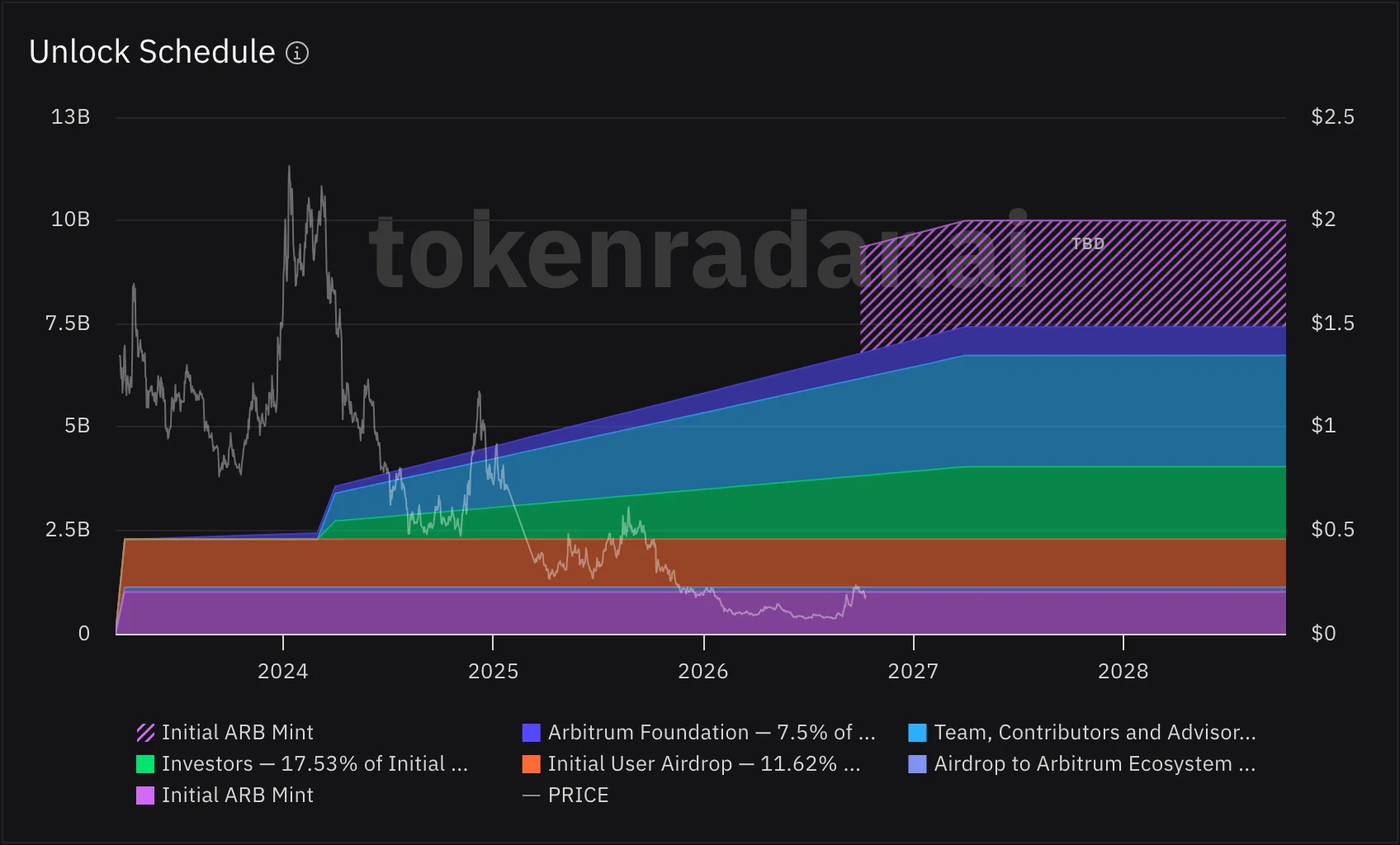
The hatched TBD band is minted supply without a release date in the sources: 2.57 billion ARB, the parts the Assumptions section lists as undated, such as the DAO treasury and its grant programs. An unlock is not a sale; our explainer on what a token unlock is covers what happens on the day.
How do emissions, burns and buybacks change supply?
Beyond vesting, supply moves in two directions: emissions create new tokens, for example as mining or staking rewards, while burns destroy tokens and buybacks take them off the market. What matters is the net change.
Burns can be built into the protocol: Ethereum burns the base fee of every block, "removing it from circulation" (ethereum.org). A buyback reduces supply only if the bought tokens are burned; tokens held in a treasury can be sold or paid out again.
A permitted rate is not a scheduled one: Arbitrum's rules allow up to 2% inflation a year, but Token Radar's schedule shows no new ARB issuance from 10 October to 9 November 2026. The Issuance tab lists the tokens that do issue new supply, apart from vesting unlocks.
What gives a token demand?
Supply is only half of tokenomics; the other half is why anyone needs the token. The common uses, and the question each one raises:
| Use | Why holders need the token | Question to ask |
|---|---|---|
| Network fees | Transactions are paid in the token | Are fees paid in this token or in another one? |
| Staking | Stakers secure the network and earn rewards | Do the rewards come from fees or from new issuance? |
| Governance | Votes decide upgrades and treasury spending | Does a vote control anything of value? |
| Collateral | Lending markets accept it as a deposit | Where is it accepted as collateral? |
| Fee or revenue share | Holders receive part of the protocol's income | Is the payout funded by revenue or by the treasury? |
Arbitrum is a governance token by its own description: Token Radar's Tokenomics & Utility section says "ARB's main role is voting", and using Arbitrum One does not require holding ARB, because its network fees are paid in ETH.
A stated use is not the same as real usage. Ask whether holders need the token to use the product, or whether the product works just as well without it.
How does tokenomics affect a token's price?
Price is where supply meets demand. Tokenomics describes the supply side in advance (how much new supply is scheduled, from whom and when), so it shows what the market will have to absorb; it cannot tell you what the price will do.
Supply overhang is the part of the supply that does not circulate yet but is expected to reach the market later. Market cap (price × circulating supply) divided by fully diluted valuation (FDV, price × max supply on Token Radar) measures it. The lower the share, the more supply is still to come; the FDV vs market cap guide works through the ratio.
| Token | Circulating share of max supply |
|---|---|
| Bitcoin (BTC) | 96% |
| Arbitrum (ARB) | 68% |
| Worldcoin (WLD) | 38% |
| Humanity Protocol (H) | 21% |
The next month's unlocks of the same four tokens follow that order: the smaller the circulating share, the larger the unlock against market cap. Data as of 2026-10-10 02:02 UTC at prices of 2026-10-10 00:00 UTC, source: Token Radar.
| Token | Unlocking 10 October to 9 November 2026 | Share of market cap |
|---|---|---|
| Bitcoin (BTC) | No unlock schedule on Token Radar | |
| Arbitrum (ARB) | $19.6M | |
| Worldcoin (WLD) | $44.9M | |
| Humanity Protocol (H) | $15.8M |
How much one unlock matters depends on its size against market cap and trading volume, who receives the tokens, and whether it is a cliff or a steady stream. Our guide on how to find upcoming token unlocks shows how to size an event.
What do good tokenomics look like?
There is no single standard, and good tokenomics do not guarantee a good investment. Researchers usually check six traits; here they are, read on Arbitrum:
| Trait | What to look for | Arbitrum (ARB) |
|---|---|---|
| Clear supply rules | A hard cap or a stated issuance policy | 10 billion minted at launch; inflation of up to 2% a year permitted |
| Float | Most of the supply circulating, or a schedule for the rest | 68% of the max supply circulating |
| Insider share | Disclosed shares for the team and investors | 44.47% for the team, contributors, advisors and investors |
| Insider vesting | A long, gradual release, not one block soon after launch | A one-year cliff, then monthly installments to March 2027 |
| Public, sourced schedule | Dates and amounts you can check against documents | 14 sources; 2.57 billion ARB without a release date |
| Real utility | A use that holders need | Voting; network fees are paid in ETH |
Treat this as a list of questions, not a score. Different projects make different trade-offs, and strong usage can offset a trait that looks weak on paper.
How to read a token's tokenomics on Token Radar
A token with researched supply data has a Tokenomics tab. Take Arbitrum tokenomics as the example; Plasma and Worldcoin use the same layout. Six steps cover any token:
- Open the Tokenomics tab from the token's page.
- Read the Unlock Schedule chart (shown above for Arbitrum) and hover a date to see what unlocks.
- Check the Tokenomics Overview for how much is unlocked and when the dated releases end.
- Read Tokenomics & Utility for what the token is used for and how its supply works.
- Check Assumptions and Sources for the allocations without dates and the documents behind the schedule.
- Compare across tokens on Token Unlocks (% MCap) and its Issuance tab (Inflation / yr).
The Tokenomics Overview sums up the schedule in six fields. For Arbitrum:
- Total Supply: N/A, a field the schedule cannot fill.
- Unlocked Supply: 6.79B ARB.
- Unlock Progress: a dash, for the same reason.
- Genesis Date: Mar 16, 2023.
- Fully Unlocked: Apr 17, 2027, when the dated releases end.
- Allocations: 18.
The Assumptions section summarizes the research behind the schedule and names what the sources do not date. For Arbitrum, many grant payments from the DAO treasury have no established dates, so they are not plotted.
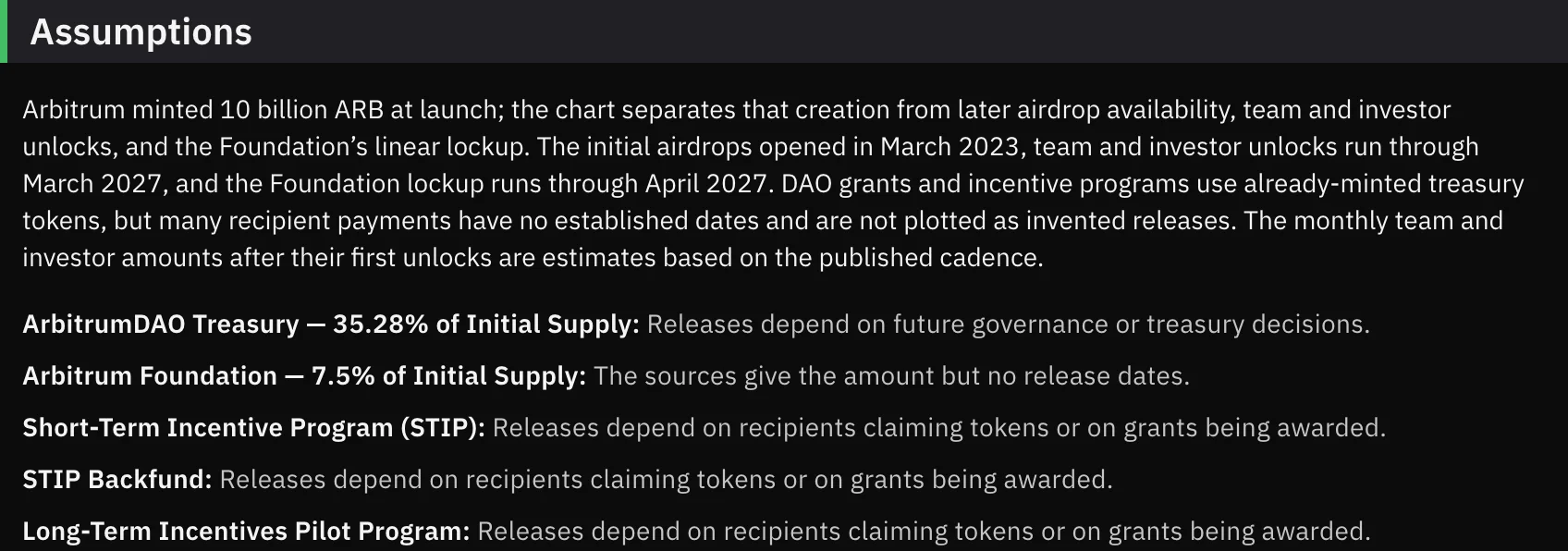
The page also shows when the schedule was last updated. For a step-by-step product walkthrough, see the Help Center article Token Tokenomics; to go beyond one token, filter by price and volume in the screener or see how its group performs on sectors.
Guides in this topic
- FDV vs market cap: what circulating, total and max supply mean, and how to read the gap between fully diluted valuation and market cap.
- What is a token unlock?: cliff and linear vesting, and what happens when locked tokens become transferable.
- How to find upcoming token unlocks: a repeatable workflow for finding unlock schedules and sizing each event.
- Token unlocks this month: a monthly roundup of the largest upcoming unlocks, with links to each token's schedule.