
What is a token unlock? Cliff vs linear vesting explained
What a token unlock is, cliff vs linear vesting, and what happens on the day, shown on Arbitrum's real schedule: a one-year cliff, then monthly unlocks.
 Written by taika · Creator of Token Radar
 A token unlock is the scheduled moment when previously locked tokens become transferable by the people or entities they were allocated to. Vesting is the schedule that sets those dates.
Unlocks add to the tokens that can move, so they are one of the main inputs to a token's supply over time. For the full picture of supply, allocations and valuation, start with our guide to what tokenomics is; this page explains the mechanics on Arbitrum's real schedule, and why almost all new supply arrives quietly:
- Unlocking in the next 30 days
- $706.4M
- at today’s prices
- Tokens with a release
- 176
- From cliffs
- 0.05%
- $353.6K, 2 tokens
What is a token unlock?
Most crypto projects do not put their full supply into circulation at launch. Shares for the team, investors, the ecosystem, a treasury and the community are locked in a vesting contract, with a custodian or by agreement, and an unlock is the date on which some of them become available to their recipient.
Every unlock comes down to three facts. Arbitrum's next one shows them:
| Fact | Arbitrum's next unlock | Watch for |
|---|---|---|
| When | 16 October 2026 | Some releases are dated only to a month, shown as "Oct 2026 · day not given". |
| How many | 92.6 million ARB, about $16.9M | The token amount is fixed; the dollar value moves with the price. |
| Who | Team, contributors and advisors; investors | The allocation says who receives the tokens, not what they will do with them. |
An unlock is a scheduled event, not a market event: it changes what recipients are able to do with their tokens, not what they will do. Arbitrum data as of 10 October 2026, 02:08 UTC, source: Token Radar.
What is token vesting and a vesting schedule?
Token vesting is the rule set that decides when allocated tokens become the recipient's to use. A vesting schedule writes those rules down as a timetable: for each allocation, how many tokens it holds, when the first release happens, and how the rest follows.
Vesting gives a team a reason to keep building for years and stops early investors from selling their whole position on the first day of trading. Not every part of a schedule is equally certain, as Arbitrum shows:
| Part of the schedule | Arbitrum | How certain |
|---|---|---|
| Dated in the project's documents | The one-year cliff of the team and investors on 16 March 2024 | Researched: the date comes from the Arbitrum Foundation's documentation. |
| Modelled from a described cadence | The monthly team and investor installments after the cliff | Estimated: the documentation says "monthly cadence"; Token Radar models equal installments on the 16th. |
| Left to future decisions | The ArbitrumDAO Treasury, 3.528 billion of the 10 billion ARB | No dates: releases depend on future governance or treasury decisions. |
The Assumptions section of Arbitrum's Tokenomics tab says the same: the monthly amounts after the first unlocks "are estimates based on the published cadence", and treasury payments without established dates "are not plotted as invented releases". When you read any unlock data, check which of the three parts you are looking at.
Cliff vs linear vesting: what is the difference?
A cliff releases a block of tokens on a single date after a waiting period; before it, nothing from that allocation is available. Linear vesting releases tokens gradually, every day or in monthly or quarterly installments, and most schedules combine the two.
Side by side, with Arbitrum and the next 30 days of unlocks on Token Radar as the examples:
| Cliff | Linear | Installments | |
|---|---|---|---|
| How it releases | One block | A little daily | Equal steps |
| On a calendar | One large step | Every day | Monthly or quarterly |
| Arbitrum | 1.11B ARB, 16 Mar 2024 | Foundation, 700M ARB to Apr 2027 | 92.6M ARB on the 16th |
| Next 30 days | $353.6K, 2 tokens | $279.9M, 109 tokens | $421.4M, 69 tokens |
Cliffs are loud, but linear vesting is large: no single day of it looks big, yet over a month it adds far more supply. A calendar that shows only cliffs misses almost all of it. Data as of 10 October 2026, 02:02 UTC, source: Token Radar.
Example: Arbitrum's one-year cliff, then monthly installments
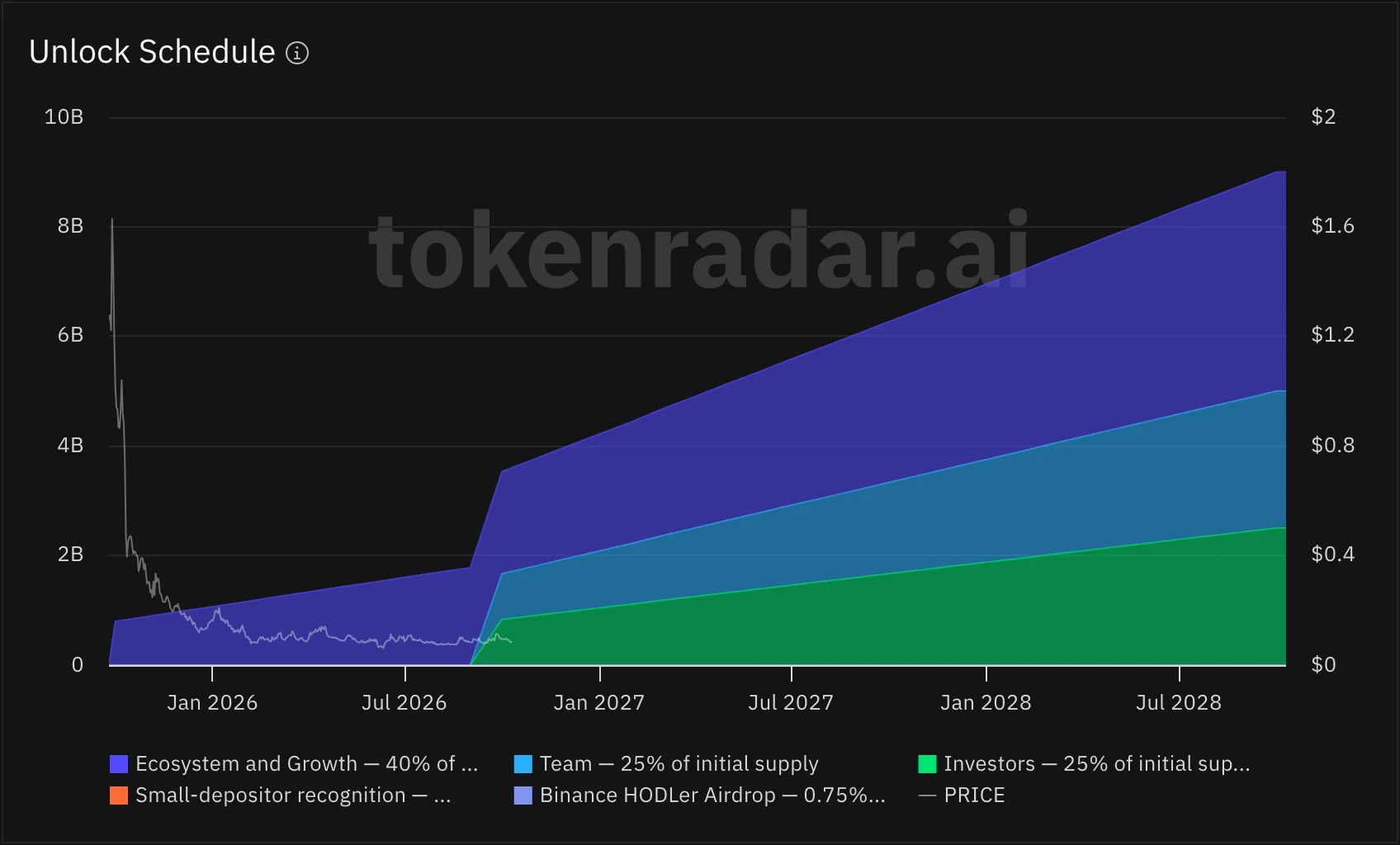
Arbitrum (ARB) shows all three shapes on one schedule. In Token Radar's model, built from the Arbitrum Foundation's documentation:
- 23 March 2023, the airdrop: claims for the user and DAO airdrops opened with 1.275 billion ARB.
- Months 1 to 12: the team, contributors and advisors and the investors receive nothing.
- 16 March 2024, the cliff: one year after launch, 673.5 million ARB for the team and 438.25 million ARB for investors unlock on one day, 1.11 billion ARB in total.
- April 2024 to March 2027, monthly installments: the rest of both allocations unlocks in 36 equal installments on the 16th of each month, about 92.6 million ARB a month.
- Alongside, continuous vesting: the Arbitrum Foundation's 700 million ARB vest every day until April 2027.
| Quarter | ARB unlocked |
|---|---|
| Q1 2023 | 1.3B ARB |
| Q2 2023 | 35.9M ARB |
| Q3 2023 | 44.1M ARB |
| Q4 2023 | 44.1M ARB |
| Q1 2024 | 1.2B ARB |
| Q2 2024 | 321.5M ARB |
| Q3 2024 | 322M ARB |
| Q4 2024 | 322M ARB |
| Q1 2025 | 321.1M ARB |
| Q2 2025 | 321.5M ARB |
| Q3 2025 | 322M ARB |
| Q4 2025 | 322M ARB |
| Q1 2026 | 321.1M ARB |
| Q2 2026 | 321.5M ARB |
| Q3 2026 | 322M ARB |
| Q4 2026 | 322M ARB |
| Q1 2027 | 321.1M ARB |
| Q2 2027 | 7.7M ARB |
The cliff was a quarter of each allocation, twelve monthly installments released on one day. The 36 installments that followed released three times as much, about 322 million ARB every quarter. Data as of 9 October 2026, 22:53 UTC, source: Token Radar.
The unlock calendar shows both cadences side by side. Filtered to Arbitrum, the Foundation's continuous vesting adds $87.5K on every day, and the team and investor installments lift 16 October 2026 to $17M, 1.37% of Arbitrum's market cap. Captured 10 October 2026, 01:29 UTC, source: Token Radar.
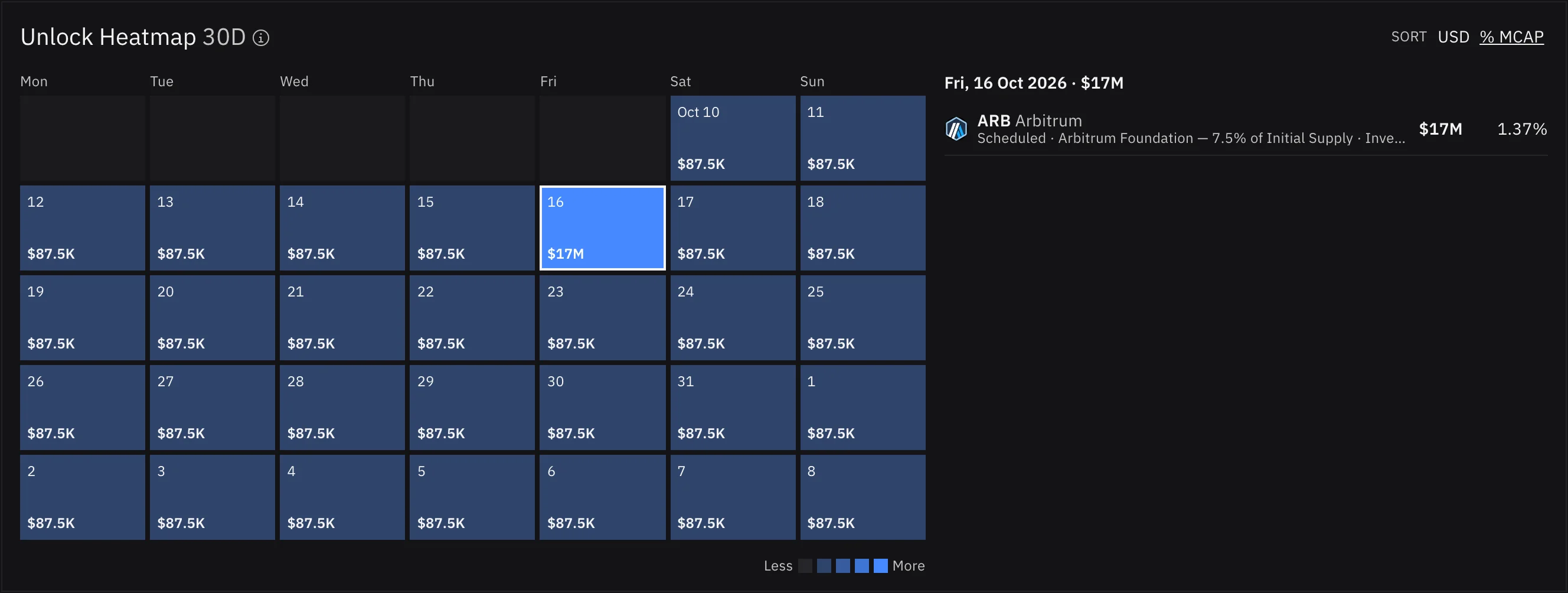
Token Radar dates each release by its cadence:
- Installments fall on their payment date, like Arbitrum's team and investor installments on the 16th.
- Continuous vesting accrues every second and shows as a daily amount, like the Foundation's $87.5K.
- Month-only releases, which the sources date to a month but not a day, read "Oct 2026 · day not given" and are spread evenly over the month's days in daily charts.
A source that rounds the same vesting into monthly totals, or counts it per block, can show different numbers for a given day or month even when the underlying schedule is the same.
Who receives token unlocks?
Each allocation has its own recipient and its own terms. Projects name their allocations in their own words, but most fall into five groups:
| Recipient | Typical terms | Watch for |
|---|---|---|
| Team and advisors: founders, employees, contributors | A cliff, then multi-year linear vesting | Releases continue for years after launch. |
| Investors: seed, private and strategic rounds | Cliff and linear terms similar to the team's | They bought before launch, often below the market price, and may take profit. |
| Ecosystem: grants, incentives, partnerships | Released over time or at the project's discretion | The timing is often partly unknown. |
| Treasury or foundation: reserves of the project or its governance | A lockup, or releases by governance decision | Unlocked treasury tokens may stay unspent for a long time. |
| Community and airdrop: users | Sometimes fully unlocked at launch, sometimes vested | Arbitrum's airdrop made 1.275 billion ARB claimable on one day. |
Several recipients often receive on the same day. On 25 October 2026, three allocations of Plasma (XPL) get an installment at once: the team $5.9M, investors $5.9M and the ecosystem fund $7.5M, together 5.0% of its market cap. Data as of 10 October 2026, 02:02 UTC, source: Token Radar.
The recipient matters because incentives differ: an investor who bought early may take profit, while a treasury may hold for years. The label tells you who receives the tokens, not what they will do with them.
What happens when a token unlocks?
When a token unlocks, the tokens become eligible for release to their recipient, and nothing more. Unlock, claim, transfer and sale are four separate events that are often merged into one:
The claim, when the recipient withdraws the tokens from the vesting contract or custodian, can come on the day, weeks later or not for a long time. A transfer to an exchange or a market maker makes a sale possible, but it does not prove one.
That is why the cliff cards on Token Radar label their chart "Modeled gross release": the most that could reach the market, not what was sold.
Are token unlocks a red flag?
Not by default. An unlock is a known, scheduled event, and the question is whether it is large next to what already trades. Three tests decide how much weight it deserves:
- Size against market cap and volume. The same dollar amount can be routine for a large token and heavy for a small one.
- Who receives the tokens. Early investors with a large gain have different incentives from a treasury or an ecosystem fund.
- What the market already knows. Schedules are usually public long in advance, so part of the supply may already be in the price.
Four real unlocks over the next 30 days show how much the first test changes the picture:
| Token | Unlocking 10 Oct to 8 Nov | Market cap | Share of market cap |
|---|---|---|---|
| Solana (SOL) | $67.9M | $64.2B | |
| Cronos (CRO) | $70.3M | $3.1B | |
| Arbitrum (ARB) | $19.6M | $1.2B | |
| Plasma (XPL) | $19.3M | $385.9M |
The calculation is one line: $19.3M ÷ $385.9M = 5.0%. Plasma and Arbitrum release about the same dollars, but Plasma's unlock weighs three times as much; Solana and Cronos also release about the same, about twenty times apart. Data as of 10 October 2026, 02:02 UTC, source: Token Radar.
The Up Next tile on Token Unlocks shows this share for every coming unlock. Read each row as:
- the date, or the month with "day not given";
- the unlock value in USD at today's price;
- the share of market cap, "of mcap";
- yellow from 2.5% and red from 5%, a reading aid, not a signal.
A related idea is overhang: a large gap between market cap and fully diluted valuation means many tokens are still to come, and our guide to FDV vs market cap explains how to read it. Whether unlocks move prices on average is still to be measured, so treat an unlock as context for research, not as a prediction.
How to see a token's unlocks on Token Radar
Token Radar publishes unlock schedules for the tokens it tracks, cliffs and linear releases alike, on four pages:
- Best for one token's whole schedule: its Tokenomics tab, for example Arbitrum tokenomics, with each allocation's unlocks over time, the price on top, the assumptions behind the schedule and its sources.
- Best for the next unlock of every token: Token Unlocks, each marked Cliff, Scheduled or Mixed, with its USD value and share of market cap.
- Best for what lands on which day: the unlock calendar, release by release, day by day.
- Best for cliffs: Largest Cliffs, one card per cliff in the selected period, with its value, its share of market cap and the evidence level of the data, such as researched or estimated.
For the next 30 days, Largest Cliffs shows just two cards, Initia (INIT) and Launch Coin, both dated only to October 2026. The cards show each release's whole October amount; the $353.6K at the top of this page counts only the 22 October days inside the 30 days. Data as of 10 October 2026, 02:02 UTC, source: Token Radar.
For a step-by-step routine, see our guide to finding upcoming token unlocks, and for this month's largest events, the token unlocks this month roundup. To see how unlocks fit with supply, allocations and FDV, read our tokenomics guide; the Help Center article Token Tokenomics explains each part of the tab, and the vocabulary defines terms such as market cap and circulating supply.